Theft As A Platform
Remember when you’d go to Office Depot, buy the latest version of Adobe Publisher, and install it on your Windows XP system? Yeah, me too. In terms of the computing world, I’m no young’un. My first input medium was punch cards. In high school. As a freshman.
Woken at the oddly specific time of 2:54 AM by yet another rocket launch shaking the house set my brain chewing on a problem dumped at my feet by an attentive piece of software. Two, actually.
I’ve subscribed to Malwarebytes for most of two decades as a quick virus scanner for my PC (A quick aside to Mac users to skirt the inevitable lecture: been there, done that, it broke down as often). Unfortunately, it misses things. Like malware downloaded while rummaging through historic images in the Florida State Archives, something that happened repeatedly enough that after my sending them details and still not finding the problem fixed, I went to the Library of Congress for my historic images instead.
But I digress. That happens when a billionaire shakes me and my house out of REM sleep and my mind is flying a million miles a minute for an hour.

A friend turned me on to Loaris Trojan Remover when those nasties wreaked havoc on my system some years back. I run it every day on Startup, and it catches things. Inevitably, the source is rarely a website, since I’ve backed off casual surfing. Instead, the malware comes injected during background downloads of – you guessed it! – software we must now subscribe to rather than buy it off that office supply store shelf and install ourselves at our leisure. Unsurprisingly, the operating system is the biggest culprit, followed by Adobe products. Occasionally other sources surprise me. But that daily scan of the system has caught them all so far, providing me peace of mind.
What it can’t catch are the background changes to Windows 11 that I don’t want. After a significant absence from my desktop, powering it up dumped it all on me at once. I’d already played whack-a-mole with OneDrive, and damned if it didn’t reappear. Before my Office 360 renewal, Microsoft advised me the annual subscription fee was going up 24%. I can’t exactly stop using Word or Excel, nor can I buy it at Staples anymore, so I didn’t protest.
I should have. For they downloaded shiny new crap I neither wanted nor needed, all with AI embedded. Trying to root out AI through Settings, I did my best. It persisted. I dug through Software and discovered both my old versions of Word and Excel and this new stinking—thing—were there. I uninstalled the new package and held my breath. Things defaulted to my old edition. Whew! Back to work. In working this problem, I read that this unwanted upgrade was the reason for the ridiculous jump in cost because it comes bundled with AI helpers. No thanks.
Well before the rocket, I had trouble falling asleep over an even more insidious discovery. About 15 years ago, in leaving a web host I was having trouble with for a more stable platform, I had to find a new email host too. Gritting my teeth, I chose Google Enterprise. I knew Gmail inherently scanned your email to feed you ads, so I did my best to keep my business email separate. Enterprise, you pay for. No ads are served. That implied they didn’t scan your email. But was that promise truly baked in?
This past week, the answer appeared to be no.
The helpful Malwarebytes newsletter threw the first red flag, followed quickly by trending topics on Bluesky. Without fanfare—without an explicit warning to paying customers—Google flipped a background switch in Gmail app settings to explicitly allow AI to read and learn from your email.
Or so it seemed.
There’s no telling how long that switch was flipped. In fact, it probably dates back to when they created tabs in which to sort your incoming mail. When I flipped the switch back, those tabs went away, dumping everything into the inbox. Instead of 630 unread emails, I now had over 19,000. Yikes!
The slippery nature of truth and honesty Big Tech offers has some wonks saying “they’d never do that to paying customers,” pointing out how legal, medical, and corporate documents would be compromised. But legal, medical, and corporate all seem to be cheering on AI these days. So why wouldn’t they?
Whether they did or didn’t on purpose, the damage is done. Just as when they scanned copyrighted books years ago and refused to remove them, they can slurp up your email archives in nanoseconds. Perhaps they already have.
A similar giant bait-and-switch faces longstanding web publishers like myself. In the name of search, Google set up rules and analytics that assured the world would find your musings in the chaos of the explosive growth of the Internet over a decade ago. They positioned themselves as an ad broker. That shifted to earning commissions off those links themselves instead of sending them to your site. With AI, they and others now have vacuumed up the repository of human knowledge embedded in websites— from hard science to utter dreck—and continue to do so on an ongoing basis. In the name of search, they gobble up your work and present it through their AI chatbots.
For those who’ve built businesses around web publishing, it’s a no-win situation. Google was founded by a couple of college students in 1998. Eight years beforehand, I was cutting my teeth on the not-so-public Internet myself in my final years of college. We had a lab with Xerox Parc machines for research, learned how to design graphical interfaces for computers using HTML when it first came out, and how to write networking protocols to pass data between computers. Xerox and Alta Vista browsers offered text search. Brand new World Wide Web URL and HTTP protocols allowed names for websites instead of numeric identification.
I bought a PC once I was introduced to AOL (America On Line) dial-up networking. I built and posted my first website in 1998. I shared photos and links to places to go and things to do, as I’d started writing travel articles for newspapers and magazines a few years before.
In a few months, FloridaHikes.com turns 20. I launched it as a place to expand on and correct information in my hiking guides. A dear friend and mentor, Lee Foster, encouraged me to launch it. I was brand-new to the Society of American Travel Writers; he hailed from Berkley and had been the earliest of early adopters of putting travel information online and getting paid for it by Compuserve, AOL, and others. He saw it as an easy way to syndicate your own work and build a loyal audience. Learning I had the same technical background, he later suggested adopting a database format versus the more popular blog format I began the site with.
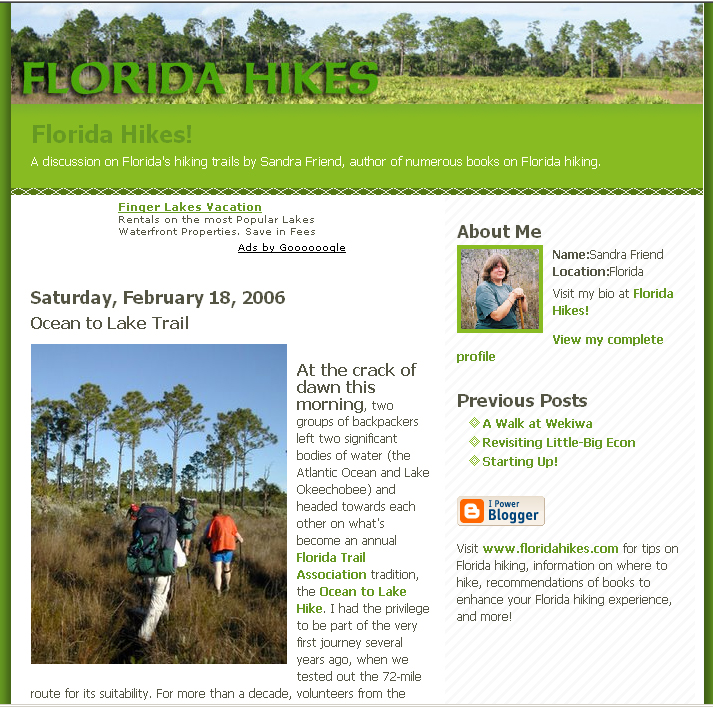
Nearly two decades and nearly 2,200 pages later, it’s still the most in-depth source of trail information in existence about Florida, every entry field-researched and many updated many times over.
For almost a full decade, a measurement of how long visitors lingered on site held steady, peaking around 2.5 minutes. That’s the average over a month or a year of how many of the millions of visitors read what we wrote. I’ve never been one to chase after search engine optimization. I’m a writer. I simply want people to read. I rarely look at the statistics behind the cover.

We run ads to cover the real costs behind web hosting and software and trail research. Despite a flood of new destinations added to the website, that income has dropped like a rock over the past two years. I dug into the analytics and discovered two horrifying facts: that 2.5 minutes of reader attention had shrunk to 16 seconds, and an insane amount of web traffic was coming from a town in Virginia. Not Florida. Why?
I looked it up. AI data centers are located there. Never mind I blocked the AI bots I was aware of in the past. Dozens more have crept onto the scene, and they’re sucking up every word we post online.
My trust in the foundational concept of the World Wide Web — sharing knowledge — has been shattered.
So yes, I’ll take those warnings about my email being scanned and sucked up into the AI maw seriously. What’s inside them includes the intellectual and creative output of my career: manuscripts and articles, published and not, sent to editors, publishers, and first readers.
Unlike the dire FBI warnings that flashed at the start of every home video for the benefit of big movie studios, no such veneer of protection has ever existed for author’s copyrights. From scanning physical books and placing them online without permission to scanning other illegal (pirated) copies of books online to teach AI how to respond to queries, Big Tech continues to flagrantly flaunt copyright law.
Baking AI into the everyday software you pay for, opting you into it without your knowledge or permission, enables ongoing theft of copyright.
As a feature, not a bug.
