Prospecting at Poland Mining Camps
One of the most enjoyable research trips I’ve done – this one for Rock & Gem magazine – was a few days deep in the Maine woods at a camp for prospectors – yep, rockhounds, those of us who love to collect minerals – called Poland Mining Camps. Since my article is no longer on their website, I present it below.
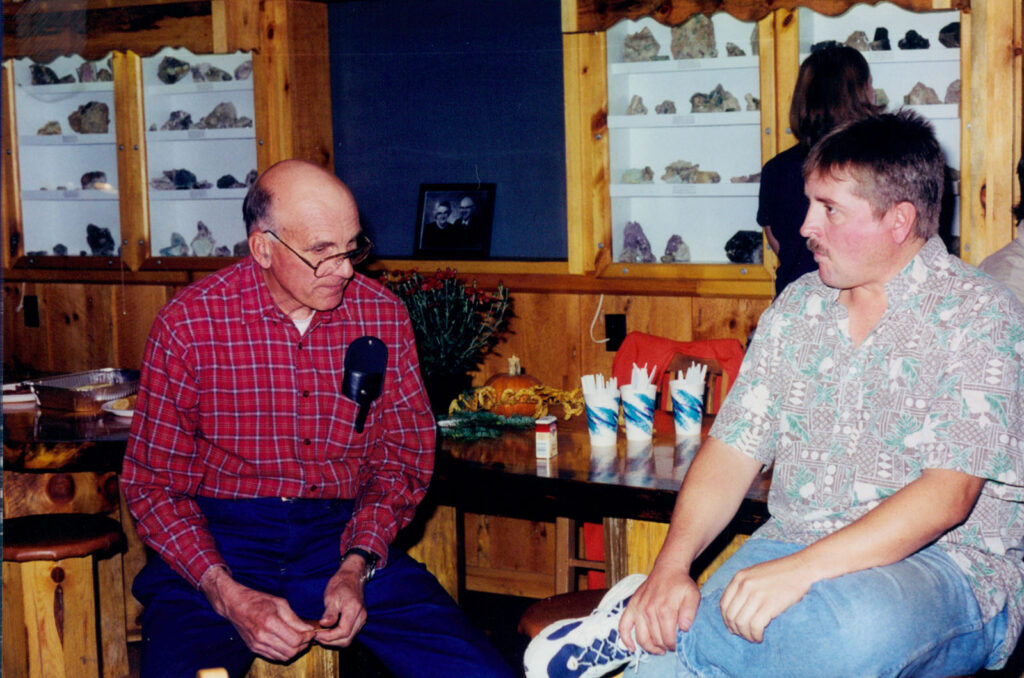
It’s a special day in Poland, Maine, home of some of the Northeast’s purest bottled spring water—and home to Irving “Dudy” Groves, one of Maine’s respected miners, owner of the Poland Mining Camps. Honey-brown white pine walls create a cozy feel in the dining hall, where collections of minerals extracted from famous Maine localities line the walls. Purple apatite, an inch thick and translucent as glass. Platy, iridescent clevelandite, encrusted with tiny sparkling crystals of muscovite. Hunks of watermelon tourmaline. A unique assemblage of globular hematite, quartz clusters, and deep purple amethyst.
The usual suspects are here. Ron Pratt, beaming about his finds. Dave and Rae Hurlbutt, who live a couple hours away, but treat Poland Mining Camps like a second home. Jo Arnone and Jaini Simon, escapees from a New York City apartment. Bob Canney, tour guide. Mike Wise and Tim Rose, regulars from the Smithsonian.
Bob plunks down a 75 lb. chunk of self-collected Maine kyanite next to the wood stove. “I found this at Dun Dee Falls. Had to carry it back to the car in my backpack, fording through ice-cold waist deep water.”
“We’d be proud to have a specimen like this,” says Tim, eyeing the sparkling blue crystals.
Dudy’s wife Mary cooks up lobster stew as the guests pour in—more than eighty of them, miners, collectors, and Maine legends—for a celebration to honor Dudy, who’ll turn eighty pretty soon. Rubbing shoulders with these folks is fun, especially since the talk revolves around minerals.
“Have you seen my piece?” Ron hands over his mineral of the week to Frank Perham— a pseudomorph cast of muscovite after schorl with a fat green apatite sitting on top of it.
Frank smiles as he looks over the specimen. “People say ‘you must have
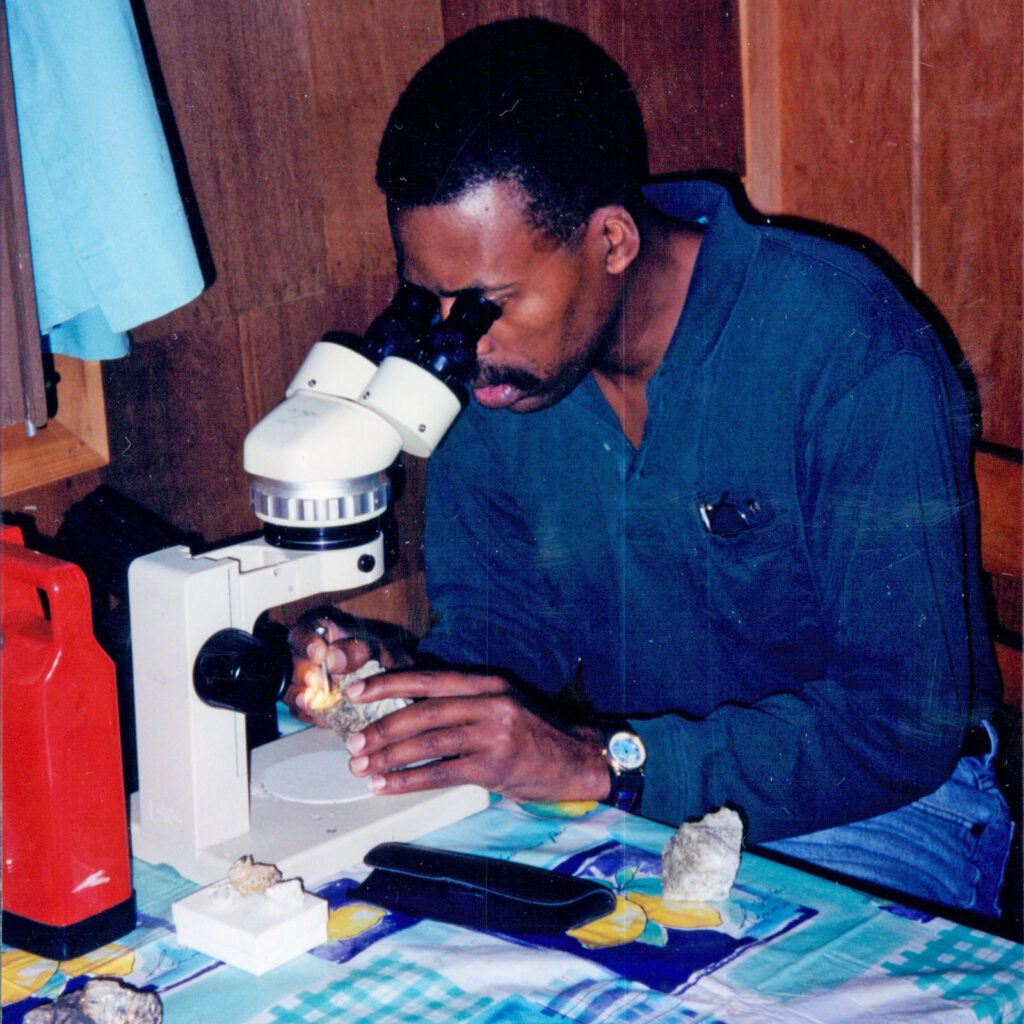
Outdoors on a pine bench, Dave is talking about his mystery mineral. He begs me to guess at it. “It’s under the ‘scope. Want to take a look at it? I haven’t seen anything like this before. It’s like there’s a wire through the apatite…”
Not like I’d know, but I follow him into the cabin and check it out. The glassy green apatite indeed has an oddly curved black stripe through it that juts out of the termination. Long, black, and thin like a ribbon.
Mike wanders in, engrossed in another mineral mystery. “Can I borrow the ‘scope?”
“Take a look at this first.” Dave ushers him to the chair.
“Hmm…hmm…” Mike gives the crystal his undivided attention for at least ten minutes, shifting it under the light, repositioning the lens. “Looks like you’ve got a columbite in there.”
Dave smiles. “That’s what Frank said.”
Ron beckons me over to look at a couple of flats of minerals laid out on his bed. “I bring these along to show newcomers that there is plenty of material to find here.”
One thick, well-formed beryl catches my eye. Almost aquamarine. “When did you find that?” I ask.
“Two weeks ago.”
He shows me a container filled with terminated bluish-green tourmaline from the Keith prospect on Mt. Apatite. “I found these about the same time.”
Gem quality. Clear. Breathtaking.
Ron’s a believer—“our adopted son,” jokes Mary. He’s visited Poland Mining Camps eleven times in the past three years. His little collection of Maine minerals is enviable. “And this is just what I grabbed on the way out of the house,” he says.
Back in the dining hall, all eyes are on Mary Groves. It’s only the third time she’s worn her stunning purple apatite. “I keep it in the safe deposit box,” she says. “I wore it for my granddaughter’s wedding, and at the Maine Mineral symposium. Doesn’t it show off well against this outfit?”
And it does, the necklace draped against the gray fabric. You could spot that stone a mile away, the way it glows with an inner fire from a perfect faceting job by Art Grant. Mary’s engagement ring, nearly as showy, is a blue tourmaline, a shade of blue that only comes from Mt. Apatite. “Dudy found it and faceted it. It means a lot to me.”
A true mineral lover, Dudy keeps what he finds when mining, and the cases that ring the dining hall are evidence to that fact. Visitors peer into each lighted case, expressing amazement at the quality and quantity of specimens. “I don’t sell anything,” Dudy says. “I may give things away, but I don’t sell them.”
Talk turns to mining stories, and the tales come thick and furious. From greedy collectors to thefts in broad daylight, the agony of watching a museum-quality morganite “smashed to bits,” the one that got away, the miner’s worst nightmare of “blowing a pocket,” it’s all served up in that thick New England drawl that leaves you wanting more. The buzz in one corner is about the Deer Hill amethyst prospect, presently closed to collecting.
The new park service representative listens to Bob explain the merits of reopening the site—“tourism, education!”—while at another table, Jane Perham discusses her book with an admirer. Looking around the room, you can tell by the way people’s faces glow as they swap stories that they love the hobby. And in a hobby like ours, it’s wonderful to be around so many of your own kind.
MORNING ON MT. APATITE
Bob and Tim introduce me to Mt. Apatite, an unassuming rise above the surrounding farmland. Its forested top, however, has yielded some of Maine’s major mineral treasures, including the famed Roebling apatite.
As we walk through the woods, Tim points out the continuous 20 degree strike of the pegmatite through the various prospects. Each quarry has its own colorful history and unique mineralogy, from the blue-green tourmalines of the Keith prospect to the deep purple apatites and glassy garnets of the Hole in the Ground.
“I haven’t missed a weekend up here (in Maine) since 1989,” Bob says. He spends much of his free time working with Frank Perham at the Morgan, Tamminen, and BB7 quarries. “Maybe I should form a Rockhounds Anonymous!”
Working the pegmatite is addictive, I soon discover. A few smacks of the sledgehammer is all it takes to break apart the feldspar and expose not just perfect ¼ inch garnets, but deep, dark green dodecahedrons of gahnite with a iridescent coating of mica. In a half-hour, I find almost a dozen—just out of the first boulder I try.
We move on to the Pulsifer and Dionne prospects for a look at the mineral formation. Tim gets excited when he sees the orange circles painted on the toe of graphic granite separating the quarries. “Looks like Dudy is planning a blast!” The Pulsifer produced Mary’s prized gemstone, along with many other fine royal deep purple apatites. Tim pokes into a sand-filled pocket in the Dionne. Earlier in the season, it yielded some perfect little quartz scepters that Dudy has on display in the dining hall. Coming up empty, he grabs a few chunks of graphic granite. “This is where I get good samples to use for education.”
Near the car, we look at the fresh diggings in the dumps of the Keith prospect. Doug Alley has been pulling out some stellar blue-green tourmaline from this area. Bob does a little excavation to stabilize the hillside. Tim and I poke around in the soft brown soil.
“I’ve got a gemstone!” Tim says. It’s rough, it’s fractured, but it’s clearly a cucumber tourmaline. Moments later, I come up with a button of clear gemmy green tourmaline. “It’s a seed,” Bob says. “That means the bigger ones are in there somewhere.”
It’ll have to wait for a return trip. Time to move on to another adventure.
HIGH-GRADING BERYL?
Never before in my life have I had enough beryl to high-grade my finds. But after a day at the Emmons—here I am, tossing out beryl!
Ray Sprague and his partner Tony Wielkiewicz work the Emmons prospect three or four days a week. “It’s an obsession,” Ray says. “We virtually live here. Tony rarely sees his apartment in the summer.”
Yesterday morning they blasted the upper wall of the pegmatite to expose fresh beryl, and our group has the first shot at it—or so we thought, until Ray discovered that some mineral poachers slipped into the mine the night before. Tire tracks are obvious in the soft dirt. Minerals are missing, and someone messed with the excavator.
From the tales I heard at the party, midnight raids, after-season poaching, theft, and vandalism are all a part of the game for these Maine miners. “It’s a big problem,” says Bob. Ray and Tony temporarily tackle the problem by replacing the lock, and discuss installing video surveillance.
Doug Alley and I clamber up to the beryl zone and start poking around, while Jo and Rae head for the apatites. Doug immediately comes up with a terminated beryl crystal more than an inch in diameter, milky bluish-green. He hands it to me.
“No, I couldn’t,” I object.
“Sure!” Doug says. “I already have one of these. I’m looking for a nice boulder for the fireplace.” Doug’s helping Dudy build a new outdoor screened lounge, an addition to the dining hall, which Mary figures will be “where the night owls can hang out and get out of my hair.” It usually takes her an hour or two to clean up after a meal, and it’s easier on her if the dining hall is empty. Plans are for the screened room to have a fireplace, a couple of couches, and a television.
I’m like a kid in a candy store, awestruck by the sheer quantity of beryl. I pick up glassy shards—aquamarine, a little too crazed for faceting, but stunning nonetheless—and anything showing a crystal habit. Using my hand sledge and chisel, I extract two whopping crystals with clean terminations. The second one is more than 2” thick and 5” long. Not gemmy, but wow—what a specimen.
After a bag lunch at the car, I climb back up to get my tools. Rock crystal— mounds of it, looking like ice – catches my eye. I scoop up a few pieces and kick over a rock. It’s another light blue beryl, 1-1/2” in diameter and almost 4” long, in matrix. I’m in beryl heaven.
“Do you want to try digging for apatite?” Ray asks. In the pit ten feet below the excavator, he points out the contact zone. “This is a wild area. You’ve got that basalt dike above, and virtually all of the minerals in this lower zone have been replaced.” He points out the pockets he and Tony have worked. “We’ve found pale pink to purple apatite in this area. You’re welcome to dig there, if you want.”
I decide to concentrate on pseudomorphs instead. Ray shows me the right types of boulder to work, and a few whacks later, I’ve got an ugly pseudomorph just like Ron’s—minus the apatite. Ray pulls down another boulder. “Give this one a shot. Looks like prime apatite territory.”
I find a ton of micros, including some perfectly double-terminated quartz crystals and tiny pink apatites. Eventually I find a larger apatite, but its head is sticking out of a vug—I can’t tell how long it is. Bob takes a look. “You called this small? This isn’t small! It’s almost the size of a pencil eraser!” No purple apatites though—and that’s what these miners are after. Tony’s looked for purples all day. He gives me a couple. “Can’t let you go away empty-handed.”
Back at the dining hall, Ray talks some more about his “obsession” with mining.
“Tony and I spend thousands – sometimes ten thousand or more – blasting and clearing the mine each year.” Ray smiles at Mary. “But for dollars a day, folks from Dudy and Mary’s can come in and look through stuff we haven’t even turned over yet. Like that boulder you were whacking—we wouldn’t have gotten to that for quite a while.”
OFF ON MY OWN
A heavy mist lies over the pines this morning. “It’ll be a rainy day today,” Mary says. “Why don’t you take a drive and check out the mineral shops? They’re all in a line, right up Rt. 26.”
I’m not much for the silver pick, but Perham’s caught my fancy with plenty books on Maine. The museum, tucked away in the front corner of the shop, shows off a whopping beryl crystal that’ll put any museum to shame—and some of the finest examples of watermelon tourmaline you’re ever bound to see.
My car started making funny noises, so I decided to cut my northbound travels short at Mount Mica Rarities in Locke Mills, where the temptation of a piece of watermelon tourmaline from the 1972 Newry find was just too much. Phil McCrillis suggested I take the car back down to the Rt. 219 garage for an opinion. “Frank will do right by you.” I did, and made an appointment for the next day.
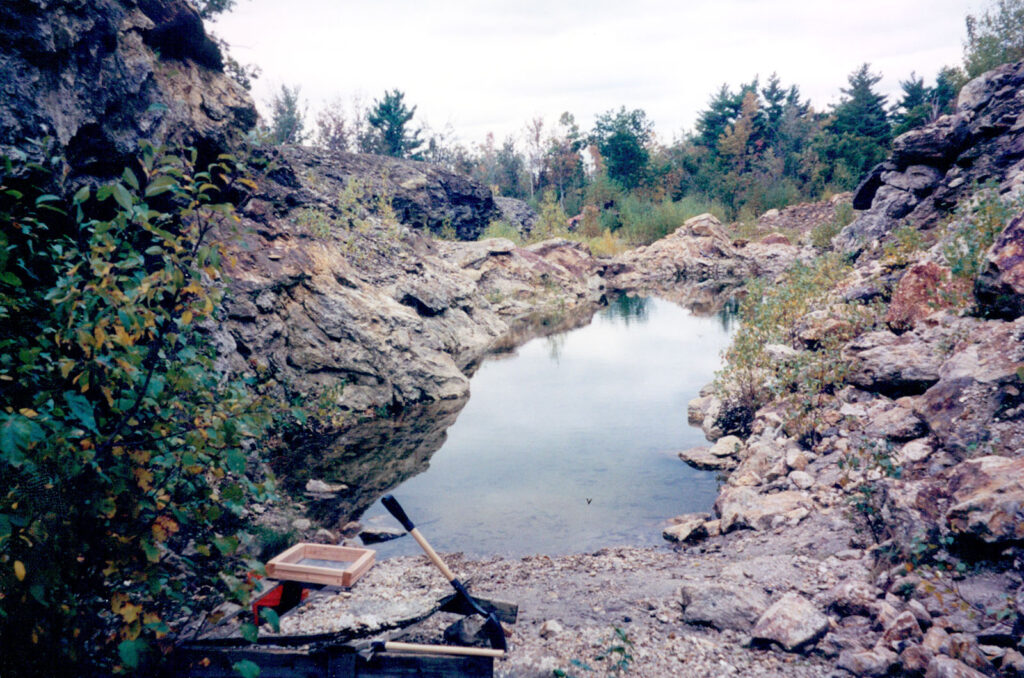
Not wanting to let the rest of the day slip by without collecting, I pulled on the rain gear and tromped down to the Greenwood quarries, using the map handed out at Perham’s. Parking is a cinch, and the walk down to the Waisanen isn’t too bad. Not too much to see there, so I followed another trail up and over to the next prospect, which I guessed to be the Tamminen. The wet feldspars show off pink, blue, and green colors, so I picked up a few pieces based on their “pretty” quotient. Scanning the rain-eroded road, I found a hunk of cucumber tourmaline, a fine little specimen in matrix. A few smoky quartz chunks went into my pockets. Finally, I can’t resist taking home a big chunk of pegmatite for the rock garden. Off I trundle, through the rain, back towards the car—and discover it’s uphill all the way. Murphy’s Law!
HELP FROM THE PROS
Mary Groves followed me up to West Paris the next day, and while Frank Perham replaced the brakes on my car, I spent the day at Mt. Mica. Mary dropped me off, and pointed out the best spots to dig. “There haven’t been any fresh blasts here in quite a few years, but people are still finding stuff!”
I worked with a shovel and a screen, digging into dumps and going through the picky process of separating the good stuff from the so-so. It was another overcast day, which dampened my mood—that, and being alone down in the pit.
“You should have come here earlier in the season!” Mary scolded, good-naturedly. “It’s more fun with a crowd!”
And she was right. I didn’t even appreciate my tourmaline finds until I showed them around that evening, with Rae and Dudy in attendance.
“Gemmy stuff!” Rae took me out the next day to Mt. Apatite, where we pounded on rock in the Hole In The Ground, and found amazing quantities of transparent little tourmalines in the Keith prospect—literally picking them up off the ground, off the rocks, from under the bushes. “You’d think someone had blown a pocket,” Rae said. “I’ve been telling Dudy there’s great stuff here, he needs to blast here again!”
She took me over to the Pitts-Tenney Garnet Mine as well, where calcite replaces giant garnets, creating massive round pseudomorphs. Excellent green diopside crystals compete with orange garnet— with a little luck and a lot of pounding, it’s possible to find some garnet that hasn’t been replaced. Up on a mountain ridge, the mine was a quiet place to sit and enjoy a lunch in the woods. But I wasn’t done yet. Bob Canney had shown me some spodumene at the BB7 mine, and I wanted to collect some for myself. After checking in with Mary, I found the former mica mine, a closed locality, and grabbed some excellent crystals, up to five inches long.
HAVING A BLAST
“We’ve saved the best for last,” Mary said. “It’s your chance to see a blast.”
Steve Welsh has worked the Berry Mine for the past 5 years. We find him down in the pit, and I don’t envy him. It’s a breezy day, chilly in the shadow of the sidewall. Steve’s standing in the hole with his waders on, in icy cold water, working a pneumatic drill. But this is the time of year he likes to work the mine—the blast doesn’t go as far, doesn’t make as much noise, and he’s not apt to get overheated.
He emerges from the pit, clothes dripping. “Well, I got my bath for today!” He drops a suction pipe into the hole to pump out the rest of the water. The gasoline-powered generator rumbles furiously. “I found lepidolite and cookite in that hole, so I’m looking for another tourmaline pocket. It’s got to be around here somewhere!”
Up at the truck, Steve shows me some of his top specimens from the past two years of collecting. In 1997, the prime material consisted of deep green and watermelon tourmaline. But in 1998, he hit a new zone of deep blue tourmaline. He hands me a crystal.
“Hold that up to the sun. See the deep aqua color? Now take a look through the end.” I do, and am taken aback—the color changes to emerald. It’s one of the most excellent examples of dichroism I’ve ever seen.
The feldspars here are certainly unique. They tend from yellow to pink and orange—and create beautiful zones of colored graphic granite. The graphic granite was mined for its high feldspar content, and mixed with purer Canadian feldspar to make a salable product. But the feldspar crystals are nothing to sneeze at. “See that over there?” he points to the sidewall of another pit. “That’s one big giant feldspar crystal. Got the faces and everything.” It looks to be about ten feet high, perhaps four feet across—and it’s where Mr. Berry stopped mining for feldspar in 1918.
I watch Steve lay out the blast. “That, and that are going to go first…” he points to two drill holes down low, “and that one up there goes next, so there’s already a space cleared for it to fall into. There should be a big pile of stuff here…” he points down, “and if there isn’t, I screwed up.”
Steve got his feet wet with blasting by tagging along some of the old-timers in the area, then headed to Massachusetts for formal classes. Miners must have permits and certification to be allowed to set off a blast. He points to the small drill holes. “This little diameter holes, though, are not normal for blasting. It’s what you’d call mineral-hunters blasting.”
After Steve drives his truck off the premises, we crouch down behind a gigantic dump truck, its flatbed tilted upward to act as a shield to keep the debris off of us. Surprisingly, he hands me the detonator. “When I say five, point it towards you,” Steve explains. “When I say zero, push it forward.”
He yells out the countdown at the top of his lungs, punctuating it with verbal warnings to anyone who might be within earshot. When he reaches zero, I flip the switch. Nothing happens. I hand the detonator to him, and the blast goes off like a big “thump.” The wind is blowing away from us, so it’s just powdery dust in the air.
Steve stands up and surveys the pit. “Now, we’ll see how many went.”
We walk down into the pit as he explains how the electronic denotation of dynamite works. Freshly blasted debris lies in jumbled piles; the air is thick with a sulfur smell. Steve uses the shovel to excavate the larger boulders out of the suspected pocket. “See how orange the feldspar is? It’s pocket feldspar. It’s one of those signs that you look for…” Metal scrapes on stone as we dig in. We start to find cookite and lepidolite, and dig out a thick quartz crystal with at least one clean face—and a termination.
Down in the deeper part of the pit, a dig into the suspected pocket area brings up a couple of roughed-up smoky quartz scepters. “See that cookite?” Steve says. “It’s a good thing.” We see some green in the rock, rotten tourmaline crystals. The potential bounty lies too deep for today’s effort, requiring pumping out more water. He lets me add today’s pocket quartz finds to my pack.
“There’s no profit in this,” Steve says, “but it’s a lot of fun. The thought that I might come up with the biggest pocket that’s ever been found, the next big Maine mineral discovery—that keeps me going!”
IT FEELS LIKE HOME
What does a trip to Poland Mining Camps have to offer?
The chance to mingle with mineral lovers of every persuasion, from major names in mineralogy to fledging collectors to folks who fly in from Europe to pick through pegmatite.
The certainty of meeting Maine’s active pegmatite miners. You get escorted entrance into closed localities being mined for gemstones. These miners have great trust in Dudy and Mary. Clients are screened with a cautious eye. “They can tell within an hour what kind of person you are,” said Ray. Serious mineral collectors planning to expand their collections are welcome—and dealers aren’t.
It’s a place to relax, put your feet up, and let someone else do the cooking – Mary. But I was amazed at how the regulars pitched in, doing the dishes, helping with laundry, and helping Dudy with some of the more rugged tasks around the camp. It’s a place where you can feel at home. “They didn’t know Mike and I when we first traipsed in here, but they took us right in.” Tim said. “I owe them a lot.”
The camp itself is a monument to Maine self-reliance. It encompasses 30 acres of land, and includes seven cabins and a dining hall, all built by Irving Groves himself. The dining hall is filled with tables and chairs crafted from slabs of white pine. “Dudy cut down these pines and slabbed them with a chainsaw. Feel the underside—it’s unfinished.” Mary’s voice fills with pride. “He bought a portable Alaskan mill to finish the tops, then did the sanding, varnishing, and put them all together.”
Dudy and Mary also manage a large organic garden on the premises, harvesting, canning, and freezing vegetables to be used for group meals. One unfinished cabin is in the process of being turned into a lapidary workshop.
Dudy started Poland Mining Camps in the 1960s but closed it down soon after when his wife fell ill. “He and Doris had sold their life insurance policies to buy the western quarries on Mt. Apatite,” Mary explained. Mary had been helping out caring for the couple’s farm animals when Doris, an avid collector, passed away. Dudy and Mary tied the knot in 1990. “We reopened the camp soon after, but we’ve only been actively open for the past three years.”
The folks who have come back time and again say there’s nothing like a little immersion in the hobby. “It’s hard to leave here, because it’s like leaving home,” said Jo. We don’t just come for the minerals anymore. It’s the fellowship, the people—especially Dudy and Mary—that make it worth the trip.”
Poland Mining Camps is open from Memorial Day weekend through the end of September. Lodging, all meals, and mining fees are included in one price. Minimum stay of three days required. Collectors must bring their own tools. Call 207-998-2350 for reservations and a map, or write to Poland Mining Camps, PO Box 26, Poland, Maine 04274.
Published in Rock & Gem , 2000. Since replaced on their website with a newer article.
